

The Smarter Way to Manufacture
Streamline production, track operations in real time, and optimize every stage of manufacturing with one intelligent system.
What is ERPNext Manufacturing Module?
The ERPNext Manufacturing Module is built for companies that need accuracy, speed, and complete visibility into their operations. Modern manufacturing cannot be coordinated manually. It needs one system that brings planning, scheduling, materials, operations, quality, and costs together smoothly. This module provides you with a complete integrated Manufacturing ERP Solution to accomplish tough tasks with clean production automation, real-time insights, and structured control. Zikpro offers this module with a more refined way of putting it into action that boosts up the production efficiency and helps businesses keep up their output at a steady pace.
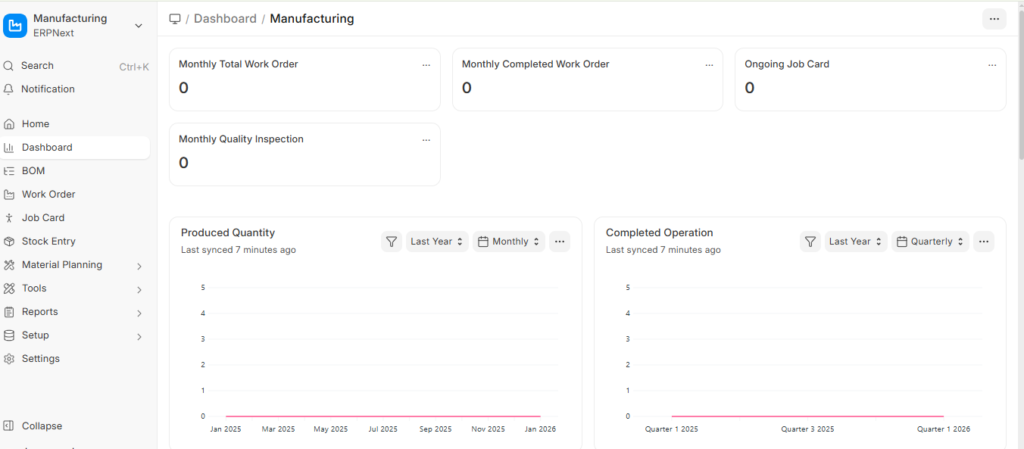
A full look at the Manufacturing Module
This module integrates all the Production activities into a single digital ecosystem.
Core capabilities include:
- Bill of Materials (BOM) management
- Production planning and scheduling
- Work orders and routing
- Shop floor management
- Advanced MRP (Material Requirements Planning)
- Full traceability from raw material to finished goods
This module provides manufacturers of all sizes with a clean interface, strong automation and scalable architecture.
Production Planning and Capacity Scheduling
Capacity Scheduling and Production Planning
Planning and scheduling features:
- Capacity planning in terms of machines, labour and availability
- Fair distribution of workload on workstations
- Planned and pending operations visibility
- Identifying and resolving bottlenecks
- Live schedule changes
That makes production planning more predictable and more strategic.
Material Requirements Planning (MRP)
Material requirements are automatically calculated by ERPNext MRP system.
MRP features include:
- Sales order-driven demand forecasting
- Identifying inventory gaps
- Recommendations for purchasing and manufacturing
- Alerts for timely procurement
- Fewer shortages and surpluses of stock
This guarantees smooth flow of production at optimised costs.
Bill of Materials (BOM) Management
ERPNext BOM accurately defines the structure of the product.
BOM capabilities:
- BOMs (single-level and multi-level)
- Routing steps, operations, components
- Processing of scrap and alternative materials
- Estimating the cost of the product
- version control of design changes
All updates are updated in the system instantly for high accuracy production.
Work Order and Operation Tracking
Work Orders are used to define and control the production execution.
Work order features:
- Step by step production instructions
- Distribution of tasks and materials
- Real time progress tracking
- Monitoring of machine usage
- Tracking material consumption
- Full traceability of each order
It enhances accountability and reduces production errors.
Shop Floor Management
ERPNext offers a digital shop floor environment.
Shop floor tools include:
- Execution of tasks with tablets or screens
- Operator instructions and data entry
- Production quality control
- Work center and cycle control
- Labour allocation tracking
Replace paper-based processes with transparent digital workflows
Real-Time Production Monitoring
Real-time monitoring of production performance.
Real-time insights include:
- Production progress
- The use of machines
- Operator performance
- Production hold or breakdown
- Variability of amount
This knowledge helps ensure the operation is accurate and always improving.
Inventory and Warehouse Integration
Manufacturing is deeply related to the inventory.
Inventory integration includes:
- Material movement in real time
- Monitoring of raw, semi-finished and finished products
- Batch and serial tracking
- Stock transfers and corrections
This prevents stock mismatches and maintains workflow continuity.
Quality Control and Inspections
Quality assurance on every level.
Quality features include:
- Inspection of incoming material
- In-process quality control
- Inspections of final products
- Deviance and defect recording
- Reorder level tracking
This ensures quality consistency and compliance.
Costing and Variance Analysis
ERPNext ensures accurate manufacturing cost computation.
Cost analysis includes:
- Cost of raw material
- Cost of labor
- Overhead allocation
- Hourly machine rates
- Impact of Scrap & Waste
- Inefficiency variance analysis
This allows companies to control and minimize production costs.
Batch, Serial Tracking, and Traceability
Full traceability throughout the entire manufacturing life cycle.
Traceability features include:
- Traceability of batch and serial numbers
- Auditable records
- Help with compliance
- Full visibility from purchase to delivery
Equipment Maintenance Management
Maintenance tools help to ensure continuous production.
Maintenance capabilities include:
- Scheduling of preventative maintenance
- Logging of breakdowns
- Tracking downtime
- Management of spare parts
This results in increased equipment availability and reduced downtime.
Automation with IoT and Barcodes
ERPNext is Industry 4.0 ready.
Automation features include:
- Barcode scanning of materials
- Data entry automation for workstations
- Integration of quality metrics
- Shop floor activity real-time tracking
- IoT system integration
These tools speed up work, improve accuracy and efficiency.
Working with Other ERPNext Modules
ERPNext Manufacturing Module works with other ERPNext modules to make a workflow that is connected.
Integrated processes include:
ERPNext Manufacturing integrates with the Selling Module for
demand forecasting, the Buying Module for material procurement,
the Accounting Module for costing and valuation, and the
HR & Payroll Module for workforce tracking — creating one
connected production ecosystem.
This completes the full Manufacturing ERP ecosystem.
Why Every Business Needs ERPNext Manufacturing?
One Fully Connected System
The ERPNext Manufacturing Module provides a complete integrated solution for high performance manufacturing operations.
Key benefits include:
- Smart automation and organised workflows
- Visibility and real-time insights
- Precise planning and cost control
- Decreased errors and less operational downtime
- Future-ready, scalable manufacturing system
Zikpro’s expert implementation allows businesses to make manufacturing a structured, data-driven and growth-focused operation.